


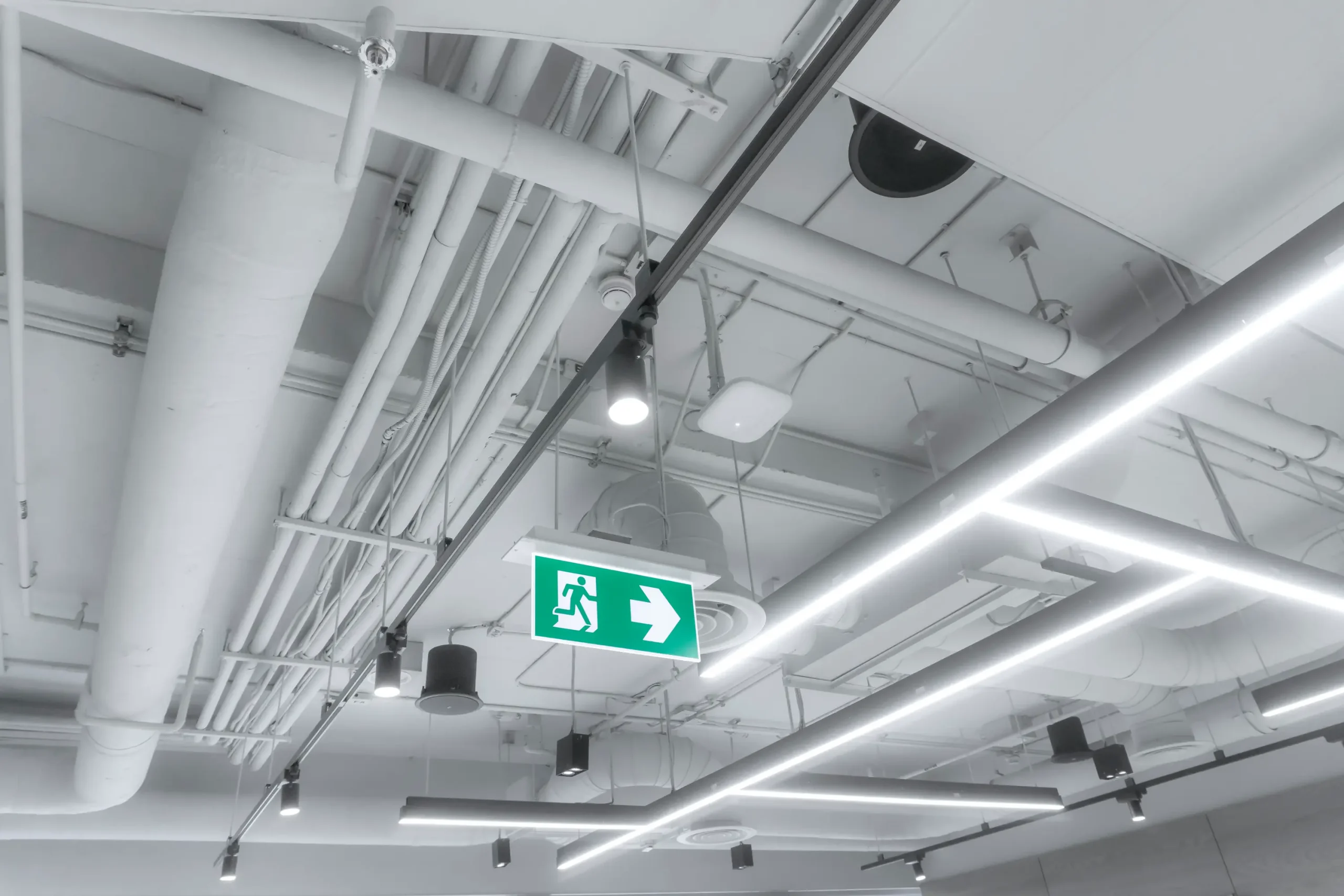
BS 5266-1:2025 Explained: What the New Emergency Lighting Standard Means for Building Owners
Introduction: why BS 5266-1:2025 matters now
The publication of BS 5266-1:2025 marks a significant moment for emergency lighting in the UK. Rather than a routine update, the revised standard reflects a broader shift in how life safety systems are expected to perform in modern buildings. As layouts become more complex and evacuation strategies more varied, emergency lighting is no longer viewed as a passive fallback but as an active part of building safety management.
For building owners and responsible persons, BS 5266-1:2025 raises the bar on clarity, consistency, and accountability. It strengthens expectations around how systems are designed, verified, and maintained over time, aligning emergency lighting more closely with real-world risk rather than historic assumptions. This matters not only for compliance, but for demonstrating due diligence in the event of inspection, audit, or incident.
Understanding what has changed, and why, is now essential. Organisations that continue to rely on outdated interpretations risk falling behind current best practice, increasing both safety exposure and regulatory risk as enforcement expectations evolve.
What is BS 5266-1:2025?
BS 5266-1:2025 is the latest edition of the UK code of practice for the emergency lighting of premises. It sets out recommendations for the design, installation, operation, and maintenance of emergency lighting systems to support safe evacuation, occupant protection, and continuity of critical activities during a loss of normal lighting.
The standard applies to most non-domestic buildings and communal areas, covering a wide range of environments from offices and retail premises to healthcare, education, and transport-related facilities. It provides a structured framework for assessing risk, determining appropriate lighting provision, and ensuring systems perform as intended throughout their lifecycle.
BS 5266-1:2025 is published by the British Standards Institution, whose role is to develop consensus-based standards that reflect legislation, European alignment, and practical industry experience. As the British Standards Institution explains, the 2025 revision expands the scope of emergency lighting, strengthens guidance on verification and documentation, and supports a more consistent approach to safety across different building types.
By following BS 5266-1:2025, organisations are better placed to align emergency lighting provision with UK fire safety expectations, demonstrating that systems have been designed and managed in line with current, recognised best practice.
Why BS 5266-1 was updated in 2025
The update to BS 5266-1 reflects how buildings, risks, and operational expectations have changed over time. Many modern premises are now multi-use, densely occupied, or reliant on progressive evacuation and stay-put strategies rather than simple full evacuation scenarios. Emergency lighting guidance needed to evolve to reflect these realities.
Another key driver was alignment with updated European standards, particularly EN 1838:2024 and EN 50172:2024. These standards place greater emphasis on photometric performance, verification, and consistency in how emergency lighting is measured and maintained. Bringing BS 5266-1 into closer alignment reduces ambiguity for designers, installers, and duty holders, and supports more predictable system performance.
Practical industry experience has also played a significant role. Issues such as battery degradation, circuit vulnerability, and inconsistent record keeping have highlighted gaps between theoretical compliance and real-world performance. The 2025 revision responds by reinforcing expectations around testing regimes, documentation, and system resilience.
This shift places greater importance on competence and governance. Independent assessment and third-party certification have become increasingly relevant as a way to demonstrate that emergency lighting systems are not only installed, but designed and managed by appropriately qualified professionals. Connected Light’s achievement of BAFE SP203-4 certification is one example of how third-party oversight supports the intent of BS 5266-1:2025 by providing audited assurance of competence, process, and compliance.
Scope expansion: escape lighting, local area lighting, standby lighting
One of the most important changes in BS 5266-1:2025 is the formal expansion of scope beyond emergency escape lighting alone. Earlier editions were primarily interpreted around evacuation scenarios, often leaving other forms of emergency illumination inconsistently specified or justified through risk assessment. The 2025 revision removes this ambiguity by clearly defining three distinct emergency lighting purposes.
Emergency escape lighting remains the foundation of the standard. Its role is to illuminate escape routes, exits, and key safety features so occupants can leave a building safely during an emergency. This includes corridors, stairways, changes in floor level, and final exits. In practice, escape lighting is the aspect most frequently scrutinised during inspections, which is why many organisations now rely on structured emergency lighting compliance frameworks rather than informal maintenance approaches.
Local area lighting is now explicitly recognised as a separate requirement. This form of lighting supports the safe shutdown of hazardous activities before evacuation can occur. Typical examples include plant rooms, control panels, laboratories, workshops, and areas containing moving machinery. The inclusion of local area lighting reflects the reality that immediate evacuation is not always the safest option, particularly in complex operational environments.
Standby lighting completes the expanded scope. Unlike escape lighting, standby lighting is designed to allow normal activities to continue during a loss of mains power. This is particularly relevant in healthcare, transport, data centres, and certain industrial environments where occupants may be required to remain in place. In these settings, emergency lighting strategies are increasingly delivered under independently verified frameworks such as BAFE-certified emergency lighting services to provide assurance around system intent and performance.

Key technical and compliance changes introduced
BS 5266-1:2025 introduces a series of technical and compliance changes that go beyond simple clarification. These updates directly affect how emergency lighting systems are designed, tested, verified, and documented.
Circuit integrity and resilience are given significantly greater emphasis. The revised standard reinforces expectations around fault tolerance, particularly in higher-risk environments, to prevent single electrical failures from disabling large sections of emergency lighting. This has implications for circuit layout, luminaire grouping, and the way systems are assessed during verification.
Escape route illuminance guidance has also evolved. Alignment with updated European standards places greater focus on achieving compliant light levels across the full width of escape routes rather than relying solely on centre-line measurements. This change increases the importance of accurate design calculations and post-installation validation, particularly where layouts or fittings have changed since installation.
Photometric verification is now more clearly embedded within long-term compliance expectations. The standard strengthens alignment with BS EN 50172 by reinforcing the need to verify that emergency lighting continues to deliver the illuminance levels originally specified. This reinforces the shift away from assumption-based compliance toward measured verification, a process increasingly delivered through structured emergency lighting compliance services.
Documentation and handover requirements have also been clarified. The revised structure places greater importance on clear records covering design intent, testing regimes, verification results, and remedial actions. These records are particularly important where competence and governance are demonstrated through third-party oversight, such as projects delivered under BAFE SP203-4 certification.
What BS 5266-1:2025 means for building owners and responsible persons
For building owners and responsible persons, BS 5266-1:2025 represents a material shift in how emergency lighting compliance is judged. Systems are no longer assessed purely on whether luminaires operate during a power failure, but on whether performance can be demonstrated against current standards.
Legal and reputational exposure increases where organisations continue to rely on assumptions based on older editions of the standard. During audits, enforcement action, or post-incident investigations, emergency lighting is increasingly evaluated against BS 5266-1:2025 expectations, not historic benchmarks. This makes proactive review essential, particularly where buildings have undergone refurbishment, changes in use, or occupancy profile.
Evidence-based compliance is now central. Clear documentation covering surveys, testing, photometric verification, and corrective actions provides defensible proof that duties have been met. Many organisations now formalise this approach through BAFE-certified emergency lighting verification and certification rather than relying on fragmented maintenance records.
There is also a governance dimension. Organisations responsible for public, educational, healthcare, or critical infrastructure environments face heightened scrutiny from regulators and insurers. Demonstrating alignment with BS 5266-1:2025 through structured emergency lighting compliance support provides confidence that responsibilities are being managed competently, consistently, and in line with current expectations.
What organisations should review following the update
The introduction of BS 5266-1:2025 makes this an appropriate point for organisations to step back and review their existing emergency lighting arrangements. The update is not intended to force immediate replacement of systems, but it does raise expectations around how suitability and performance are demonstrated.
Emergency lighting strategies should be reviewed first. This includes confirming that escape lighting, local area lighting, and standby lighting have all been considered where relevant, rather than assuming evacuation is the only credible scenario. Buildings that support complex operations or vulnerable occupants are particularly affected by this broader scope.
Risk assessments should also be revisited. Changes in layout, occupancy, or use may mean that earlier assessments no longer reflect real conditions. The updated standard reinforces the role of risk assessment as the foundation for design decisions, rather than a one-off exercise.
Verification cycles are another key consideration. Photometric verification expectations are now clearer and more prominent, meaning organisations should understand when their systems were last verified and when repeat verification is due. Testing regimes and documentation should be reviewed at the same time to ensure records are complete, accurate, and auditable.
Finally, organisations should consider the competence and governance of their service providers. Demonstrating compliance increasingly depends on independent evidence, clear records, and recognised certification rather than informal assurances.
FAQs: BS 5266-1:2025 and emergency lighting standards
What is BS 5266-1:2025 and when did it come into effect?
BS 5266-1:2025 is the latest edition of the British Standard that provides guidance on the design, installation, testing, and maintenance of emergency lighting in non-domestic premises. It was published in late 2025 and replaces the previous 2016 edition.
Is BS 5266-1:2025 a legal requirement in the UK?
British Standards are not legislation in themselves. However, BS 5266-1:2025 is widely recognised as the accepted benchmark for demonstrating compliance with UK fire safety duties. In practice, regulators, insurers, and courts often expect systems to align with the latest published standard.
How does BS 5266-1:2025 differ from BS 5266-1:2016?
The most significant difference is the expanded scope. The 2025 edition formally includes local area lighting and standby lighting alongside emergency escape lighting. It also provides clearer expectations around resilience, verification, documentation, and alignment with updated European standards.
Does BS 5266-1:2025 change emergency lighting testing requirements?
Routine monthly functional testing and annual full-duration testing remain fundamental. However, the updated standard places greater emphasis on how results are recorded, how tests are managed to avoid gaps in protection, and how performance is demonstrated over time.
What does the new standard say about photometric verification?
BS 5266-1:2025 reinforces alignment with BS EN 50172 by clarifying expectations around photometric verification. Systems should be verified initially and re-verified at defined intervals to confirm that required illuminance levels are still being achieved, rather than assumed.
Who is responsible for compliance with BS 5266-1:2025?
Responsibility sits with the building owner or the person in control of the premises, often referred to as the responsible person. This includes ensuring that systems are suitable, maintained, tested, and supported by appropriate documentation.
Do existing buildings need to be upgraded immediately?
Not necessarily. Existing systems do not automatically become non-compliant overnight. However, organisations should review their arrangements against the updated standard and address any gaps through planned improvements rather than waiting for enforcement or incident-driven scrutiny.
Summary: aligning with BS 5266-1:2025
BS 5266-1:2025 marks a clear shift in how emergency lighting is expected to be managed. The standard focuses on demonstrated performance, resilience, and evidence-based compliance rather than assumption. For organisations responsible for people and premises, now is the right moment to review strategies, documentation, and verification arrangements to ensure they remain aligned with current expectations rather than historic practice.
Why you can trust Connected Light
Connected Light operates as an independent lighting consultancy with a strong focus on governance, verification, and long-term compliance. The team works across emergency lighting design, testing, photometric verification, and certification, supporting organisations through every stage of the compliance lifecycle.
As a provider of BAFE-certified emergency lighting services, Connected Light offers third-party audited assurance that systems meet recognised industry standards. This includes expertise across BS 5266-1:2025, BS EN 1838, and BS EN 50172.
With more than 40 years of combined experience, the consultancy supports clients through surveys, verification programmes, certification, and advisory services, helping responsible persons demonstrate compliance clearly, confidently, and defensibly through structured emergency lighting compliance support.