


Smart Lighting Control on Campus: Why Universities Are Moving to Casambi and DALI
Smart lighting control lets university estates teams coordinate light for spaces used at different times, from early lectures to late library hours, while managing energy and maintenance across a large estate. If you are weighing up DALI and Casambi, the useful question is rarely which protocol should control every building. It is where each approach fits and whether a hybrid makes sense. Wired DALI can support individually addressable luminaires, scenes and planned integration; wireless Casambi can simplify control upgrades where running new control cable would be disruptive. This guide explains the differences, looks at named university and campus projects, and sets out practical questions for specification, commissioning, emergency lighting and term-time delivery.
Why campuses are rethinking lighting control
Across university buildings, operating patterns vary widely. Lecture theatres turn over several times a day, libraries stay open into the evening, laboratories have task-specific requirements, and sports spaces can sit empty for long periods. A simple on/off approach may leave estates teams with limited control over how light is used across that varied timetable.
Energy costs are one driver, but maintenance and compliance matter too. At UWE, Connected Light’s lecture-theatre project introduced a centralised emergency-lighting testing system and reports £100,000 in annual maintenance savings. Its UWE Centre for Sport project reports £24,000 in annual savings. These are outcomes from specific projects, not figures to apply to every campus without a survey and baseline.
A planned controls upgrade can address a retrofit backlog in phases as buildings are refurbished or spaces change use. A well-designed system can improve safety, comfort, efficiency and long-term value while remaining practical and compliant.
What DALI does well on a campus
What is DALI?
DALI means Digital Addressable Lighting Interface: a digital protocol that lets compatible lighting-control devices communicate. It is standardised in IEC 62386. In a typical wired DALI installation, luminaires or drivers connect to a control bus and can be addressed individually, grouped, dimmed and assigned to scenes. The DALI Alliance’s overview explains the protocol and its standardisation.
Where DALI fits
DALI lighting control is often a good fit for new buildings and major refurbishments where control cabling can be planned alongside power and other services. It can support lecture theatres, teaching blocks and larger estates that need structured zoning, scene control, or an agreed interface with a building-management system. The interface and operating responsibilities should be settled during design.
A university example
At Cardiff University’s Hadyn Ellis Building, an Open Technology case study describes about 600 DALI lighting groups controlled through eight LiGO units and linked to the campus Trend supervisor. It reports that the system also runs weekly and quarterly emergency-lighting tests and provides reports for the estates team. The case shows how lighting control and test records can be brought into a wider campus operation.
Limits to plan for
A wired DALI system needs a designed bus and a clear commissioning plan. Groups and scenes can often be changed in software, but alterations to a building, new zones, added control points or incompatible equipment may call for physical work and recommissioning. Ask for the bus routes, addresses, device compatibility, integration points, access credentials and programming ownership to be documented at handover.
What Casambi adds
What is Casambi?
Casambi is a lighting-control platform based on Bluetooth Low Energy (BLE) mesh communication. Compatible control modules can be built into luminaires, LED drivers, switches and sensors, with an app for setup and user control. A stand-alone network can operate locally without an internet connection; remote management or some building-management interfaces may need a gateway or other integration. Casambi’s system overview explains how the network and gateway options work.
Where wireless control fits
Casambi lighting control can help in retrofit areas where new control cable would be costly or disruptive, in flexible teaching and breakout spaces, and in heritage buildings where routes for additional cabling are restricted. It does not remove every need for electrical work: luminaires still need power, and the design must account for device location, radio paths and how people use each room. Casambi’s technical guidance notes that surrounding materials and obstructions can affect radio range, so site planning and testing matter.
A university example
Abertay University’s Bernard King Library introduced LED fittings controlled by Casambi, alongside more than 30 self-powered wireless switches for meeting, study, group-work and presentation rooms. The EnOcean case study describes how the switch locations could support different ways of using the library without running control cable to every switch. It does not publish an energy-saving percentage, so no percentage should be inferred.
Commissioning at scale
Larger wireless installations need careful network design, commissioning and an agreed approach to system access. Connected Light is a Casambi 4C-certified commissioning partner, with support available for Casambi projects of different sizes. We can assess radio conditions, set up control zones, test operation and prepare a usable handover.
DALI and Casambi together: choosing the right mix
DALI and Casambi are not mutually exclusive. A campus may use wired DALI where centralised control and infrastructure are already planned, and wireless Casambi in areas where local flexibility or a retrofit is the priority. The comparison below is a starting point: the chosen equipment and interfaces determine the final capabilities.
| Consideration | Wired DALI | Wireless Casambi |
|---|---|---|
| Control link | Control bus wiring is designed with the installation. | Bluetooth Low Energy mesh between compatible devices. |
| Retrofit impact | Control cabling and access need to be planned. | May avoid new control cabling; power and compatible devices are still required. |
| Changes and scale | Groups, scenes and interfaces depend on the chosen control system. | Network setup, device placement and commissioning govern expansion. |
| BMS and remote access | Specify the required controller and BMS interface. | A gateway or integration may be needed for remote or BMS access. |
| Emergency lighting | Compatible emergency gear and test interfaces must be specified. | Confirm the emergency system and interfaces separately; do not assume compatibility. |
St George’s Bristol provides a practical hybrid example. Connected Light integrated Salvador Series 1000 DALI controllers with Casambi CBU-ASD and Danlers CBU-4INPUT components. The project is a performance venue rather than a university, but it demonstrates how wired DALI equipment and wireless control can be combined when the interface is designed and commissioned as a system.
Where each approach suits campus spaces
Lecture theatres and teaching spaces
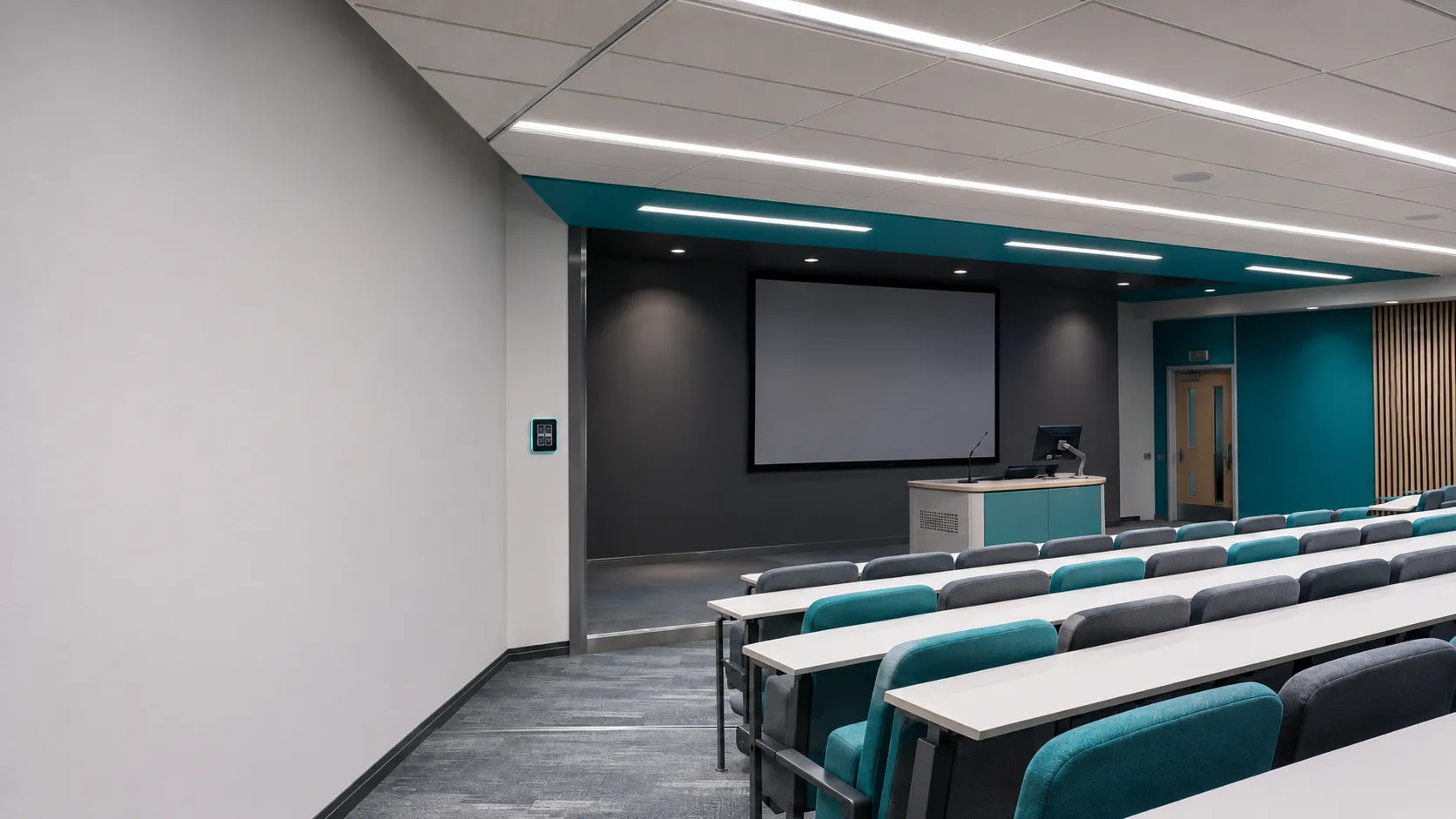
Lecture theatres often need scenes for teaching, presentations and cleaning, with local controls coordinated with audio-visual equipment. At the University of Bath’s 2 West lecture theatre, Connected Light upgraded the lighting around the existing Helvar system, with local scene control and AV integration; a BAFE-compliant certificate was issued. UWE’s lecture-theatre project shows the role of centralised testing and maintenance planning.
Libraries and study spaces
Libraries combine quiet study, group work, shelving and presentation areas, often with different operating hours. The Abertay example shows how Casambi and wireless switches can give staff control points that suit changing layouts and room uses. Where DALI is already part of the building infrastructure, it may provide a structured base for zones and scenes. In either case, confirm that the selected controls are straightforward for library staff to use.
Laboratories and specialist teaching
Laboratories and specialist teaching spaces need their lighting designed around the visual tasks, equipment layout and the applicable illuminance criteria. Control zones can help staff adapt general lighting to practical work, demonstrations or cleaning, but they should not compromise required lighting levels or emergency operation. A task-led design review is more useful than choosing a protocol first.
Sports facilities
Sports facilities can have large volumes, changing occupancy and several modes of use. The UWE Centre for Sport project combines improved lighting with smart controls, and Connected Light reports annual savings of £24,000. The design should match lighting zones to actual activities and opening patterns, with suitable local control for staff.
Heritage and listed buildings
In heritage buildings, wireless control may reduce the need for new control cabling through sensitive fabric. Casambi may be worth assessing, but stone, metalwork and thick walls can affect radio coverage. A survey and on-site testing help establish whether it will work reliably.
Emergency lighting and compliance
Smart lighting control and emergency lighting should be considered together, but general lighting controls do not replace the design, testing and records required for emergency lighting. Compatible DALI emergency control gear can support centralised functions in a properly designed system; the equipment, monitoring arrangement and test process must be specified and verified. Connected Light’s guide to BS 5266-1:2025 and its emergency-lighting compliance service explain the separate compliance work involved.
Before procurement, confirm how emergency fittings behave if the normal control network or communications fail, who receives test reports, and how faults are escalated. The project should leave the estates team with clear records, training and an agreed maintenance route.
Phasing works around term dates and occupied buildings
Plan around the academic calendar and the building’s real patterns of use. A room-by-room scope, off-site configuration and phased commissioning can reduce disruption where teaching or research must continue. Agree access, shutdowns, temporary lighting and handover dates with building users before work starts.
At Frampton Cotterell Primary School, a full lighting upgrade was completed in seven days over the summer holiday. University estates teams can use the same principle at a larger scale by dividing work into manageable zones and scheduling the most disruptive tasks for quieter periods.
Questions to ask before you specify
Before selecting a system, confirm who will own the controls after handover and how the design will be maintained. These questions help make the specification practical for your estates team:
- Who is responsible for programming, user permissions, backups and future changes?
- Which protocols and equipment are compatible with the existing installation and planned BMS links?
- Who will commission, test and train staff to use the system?
- What information is collected, where is it stored, and is remote access required?
- What does the warranty cover, and who will provide support if the building or its use changes?
How Connected Light can help
We support education estates with lighting projects planned around real-world building use, from initial assessment through to handover.
Services
- Assessment and design: We review your building, existing controls, user needs and compliance requirements before recommending a practical, compliant approach.
- Project delivery: We can support design, supply, installation, integration and commissioning across new and existing spaces.
- Training and handover: We provide documentation and training so your estates team can operate the system with confidence.
Why Connected Light
- Experience and assurance: We bring more than 40 years’ experience, BAFE SP203-4, ISO 9001 and Constructionline Gold credentials.
- Casambi expertise: As a Casambi 4C-certified commissioning partner, we can support network design and commissioning, including suitable hybrid projects.
To discuss the right control approach for your estate, BOOK CONSULTATION.
Frequently asked questions
What is the difference between DALI and Casambi?
DALI is a digital lighting-control protocol commonly installed over a wired control bus, while Casambi uses Bluetooth Low Energy mesh communication between compatible devices. Both can provide zoning and scene control. The right fit depends on existing wiring, the building fabric, integration needs, operating patterns and how the system will be commissioned and maintained.
Can DALI and Casambi be used together?
Yes. Compatible controllers and interfaces can link DALI equipment with Casambi wireless control. Connected Light’s St George’s Bristol project combines Salvador DALI controllers with Casambi components. A hybrid system needs a defined control architecture, tested compatibility and clear ownership of programming and support.
Is wireless lighting control reliable in a university building?
It can be reliable when the network is designed for the building and tested in operating conditions. Wall materials, metal enclosures, device placement and distance can affect radio communication. For larger installations, plan network design, commissioning, backups, user permissions and a route for future changes rather than treating wireless control as a plug-in addition.
Can lighting control be retrofitted without rewiring?
Casambi can often add control without installing a separate control-cable network, provided the luminaires or drivers are compatible and local radio conditions are suitable. The lighting still needs electrical power, and a project may require replacement fittings, wiring changes or additional sensors. A site survey will show what is feasible.
How does smart lighting control affect emergency lighting testing?
Controls can support centralised testing and reporting when the emergency-lighting equipment and system have been designed for it. They do not remove the need for the required emergency-lighting design, testing, records and maintenance. Confirm compatibility, failure behaviour, reporting responsibilities and the applicable standards with the project’s competent designer.