

How Much Lux Does a Classroom Need? UK Lighting Standards Explained
For a typical classroom, plan for 300 lux of maintained horizontal illuminance; technology and science classrooms are listed at 500 lux in current Department for Education school and college design criteria. Classroom lux levels are only one part of a sound lighting design: glare, uniformity, colour rendering, the task plane and the way a room is used also matter.
This guide explains the figures, shows what the current DfE technical manual says for different spaces, and sets out how to check a room. Statutory duties use broader terms such as suitable and sufficient lighting, so verify the target against the relevant task category and project specification.
Classroom lux levels at a glance
The table summarises the current DfE technical criteria for new school and college design. The listed room category matters: a general classroom and a technology or science classroom do not have the same horizontal illuminance target.
| Space category | Em (lx) | UGR max | Uniformity (Uo) | CRI / Ra |
|---|---|---|---|---|
| Primary basic teaching area | 300 lx | 19 | 0.6 | ≥80 |
| Secondary general teaching, art studio, music, SEN/support and study areas | 300 lx | 19 | 0.6 | ≥80 |
| Technology/science classroom | 500 lx | 19 | 0.6 | ≥80 |
These values come from Tables 22 and 23 in the DfE’s January 2026 Technical Manual, which specify illuminance, uniformity, glare and interior LED colour rendering. They apply to the named school and college spaces; confirm the relevant task category in BS EN 12464-1:2021. The manual sets task-plane heights of 0.55 m for primary, 0.75 m for secondary general teaching and 0.85 m for technology/science classrooms.
What is lux, and what does “maintained” mean?
Lux is a measure of illuminance: one lux equals one lumen of light falling on each square metre. In lighting tables, Em means maintained illuminance. It is the level the installation is designed to provide at the end of its planned maintenance period, after allowing for factors such as dirt and light-source depreciation, rather than only the output of a new fitting.
The working plane is the surface where the visual task takes place. For classroom desks, that is generally the desk surface, but the correct measurement height comes from the room’s design criteria. A reading taken at the wrong height, under different control settings or with daylight conditions unrecorded may not be comparable with the design target.
Which UK standards and guidance apply?
BS EN 12464-1:2021
BS EN 12464-1:2021 is the main UK reference for lighting in indoor workplaces. It sets requirements for the quantity and quality of illumination, including visual comfort and performance, and provides task-specific criteria. It does not cover emergency lighting, which is addressed through separate standards. The British Standards Institution’s summary explains the standard’s scope and confirms that the 2021 edition superseded the 2011 version.
CIBSE SLL guidance
The Society of Light and Lighting’s Lighting Guide 5 covers educational spaces including teaching rooms, lecture theatres, art rooms, sports halls and multi-purpose spaces. CIBSE currently lists the guide as the 2011 edition and notes that it is under review. Use it as supporting design guidance alongside the current standard and the project brief.
Legal duties and Department for Education guidance
The Workplace (Health, Safety and Welfare) Regulations 1992 require every workplace to have suitable and sufficient lighting. In England, regulation 8 of the School Premises (England) Regulations 2012 says lighting in each room must be suitable for the activities normally carried out there. Neither regulation gives one lux figure for every classroom. The current DfE Technical Manual provides more detailed criteria for new school and college design; requirements in Scotland, Wales and Northern Ireland should be checked against the relevant national guidance. For wider workplace context, see our guide to workplace lighting regulations.
Emergency lighting is assessed separately
Normal classroom lighting and emergency lighting serve different purposes and are assessed separately. BS EN 12464-1 is not the emergency-lighting standard; emergency lighting design and verification follow the relevant emergency-lighting standards and building risk assessment. Connected Light’s BS 5266-1:2025 explainer and emergency-lighting compliance service outline the separate requirements. Product selection matters too: choose emergency luminaires for the system and application, checking relevant British Standards, project requirements and conformity evidence. Price alone is not proof of suitability; poor or non-compliant products can undermine safe operation. The GOV.UK guidance on electrical equipment safety explains requirements before products are placed on the GB market. Do not use the normal classroom lux target as an emergency-lighting target.
Beyond lux: glare, uniformity, colour and flicker
Glare
A classroom can meet its horizontal lux target and still feel uncomfortable if the luminaires create direct glare, reflections or bright patches in pupils’ field of view. The DfE design criteria set a maximum UGR of 19 for the teaching categories shown in the table. UGR is a measure used to assess discomfort glare; it does not describe every reflection from a screen or whiteboard. Luminaire choice, shielding, layout, daylight and screen position all affect the result.
Uniformity
Uniformity describes how evenly illuminance is distributed across the task area. The DfE manual lists a uniformity value of 0.6 for the teaching categories in the table. A room with bright patches and dim corners may have an acceptable average while still leaving some desks below the intended level. The layout, spacing, optics, ceiling height and room finishes all influence the result.
Colour rendering
The DfE manual sets a colour rendering index of at least 80 for interior LED lighting in the school-design context. Colour rendering describes how naturally a light source shows colours compared with a reference source; it is not the same as lux or colour temperature. Art and design work may need more careful specification for the visual task, so do not assume that the general minimum resolves every specialist requirement.
Whiteboards and vertical surfaces
A whiteboard is a vertical task surface, so its illuminance should not be compared directly with the horizontal desk-plane target. The DfE School Output Specification lists 150 lux vertical illuminance for whiteboards, with uniformity of 0.6. The DfE’s 2026 manual also sets criteria for vertical surfaces in teaching spaces. Check the project’s current specification and consider reflections and viewing angles as well as the measured level.
Flicker and stroboscopic effects
Flicker and stroboscopic effects are not shown by a lux reading. They are affected by the driver and control gear, so product data should be checked during specification. The DfE Technical Manual sets limits for these effects in its school-design criteria: PstLM no greater than 1 and SVM no greater than 0.4. These figures relate to the specified design context and should be verified with the selected equipment.
Mixed-use rooms and evening classes
A room may be used for daytime teaching, evening adult learning, exams and practical work. The target follows the visual task and room category, not simply the time of day or the learners’ age. Dimming and scenes can help staff adapt the room while maintaining the specified level.
For rooms that change use, include the expected activities in the lighting brief and decide who can select or adjust each scene. Connected Light’s smart lighting control systems can be planned around room use, existing wiring and the way staff operate the building.
How to check your classroom lighting
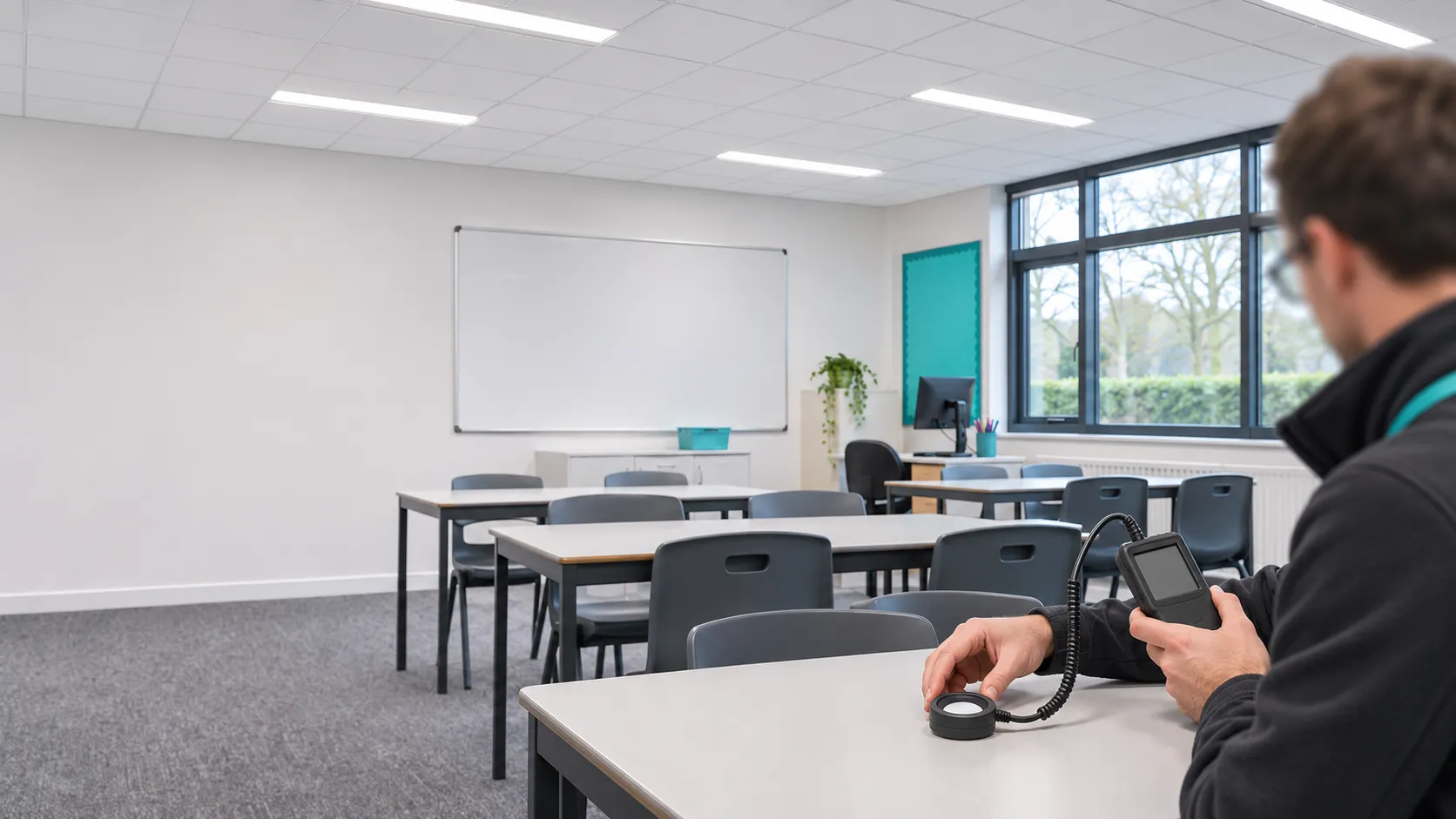
A lux meter can flag possible shortfalls when readings are compared with the correct criteria. For a useful first check:
- Confirm the target category, working-plane height and normal control setting from the design information.
- Take readings at several representative points across the task area, not only directly beneath a luminaire.
- Record daylight conditions, blinds, control settings and whether fittings are clean and operating normally.
- Compare the readings with the specified illuminance and uniformity criteria; note any glare, dark areas or failed fittings.
A professional lux survey records measurement locations and results against the relevant criteria. Connected Light’s survey service focuses on emergency-lighting compliance; for a general classroom review, discuss the scope with a lighting designer or M&E consultant.
Why older classrooms often fall short
Ageing fluorescent lamps and dirty diffusers can reduce light output, while poor optics or changes to room layouts can create glare and dark areas. Replacing fittings like for like may not correct the distribution or controls, so assess the room before specifying an upgrade.
At Bradley Stoke Community School, a Connected Light upgrade delivered £21,428 in first-year savings, a 4.5-year calculated payback and a 65% energy saving per classroom fitting. At Frampton Cotterell Primary School, a wider lighting upgrade was completed in seven days over the summer holiday. These examples show how survey, design and installation can be planned around school use; outcomes will vary by building and operating pattern.
Connected Light’s article on why outdated school lighting can cost more than expected covers maintenance, energy and disruption in more detail.
How Connected Light can help
We assess lighting for schools, colleges and universities, identify relevant criteria and plan upgrades around term dates and building use. As independent lighting specifiers, we select quality products from multiple manufacturers, check them against relevant British Standards and project requirements, and can source and supply them as part of project delivery.
Services
- Lux level surveys: We provide documented lux surveys for emergency-lighting compliance and can discuss the measurement scope needed for your project.
- LED upgrades and controls: We design lighting and controls around room use, existing infrastructure, energy goals and maintenance needs.
- Emergency lighting: Our BAFE SP203-4-certified team can support emergency-lighting design, verification and compliance documentation, and can source products selected for the specified system and project.
Why Connected Light
- Experience and assurance: We bring more than 40 years’ experience, ISO 9001 certification and Constructionline Gold status.
- Education delivery: We plan installations around term dates and work in occupied schools, colleges and universities.
To discuss a classroom survey, upgrade or wider education estate project, BOOK A CONSULTATION today.
Frequently asked questions
How much lux does a classroom need?
DfE criteria list 300 lx maintained horizontal illuminance for primary basic and secondary general teaching, and 500 lx for technology and science. Confirm the target for the room’s use.
What lux level is needed for a whiteboard?
The DfE lists 150 lx vertical illuminance and 0.6 uniformity for whiteboards. Measure the board surface and account for reflections and viewing angle.
Do evening classes need more light?
Not automatically. Set the level for the task and room category. Dimming or scenes can accommodate different users while maintaining the specified illuminance.
What is UGR and why does it matter in classrooms?
UGR assesses discomfort glare. DfE criteria set a maximum of 19 for the listed teaching spaces; reflections, windows and screen position also matter.
How often should classroom lighting levels be checked?
No fixed interval applies. Recheck after upgrades, layout changes, concerns or maintenance issues, and keep results with design records. Emergency lighting has a separate schedule.
Do emergency lighting levels have to be measured separately?
Yes. Because emergency lighting has separate safety purposes and criteria, assess it under the relevant emergency-lighting standards, risk assessment and test requirements. The 300 or 500 lux classroom targets do not apply.